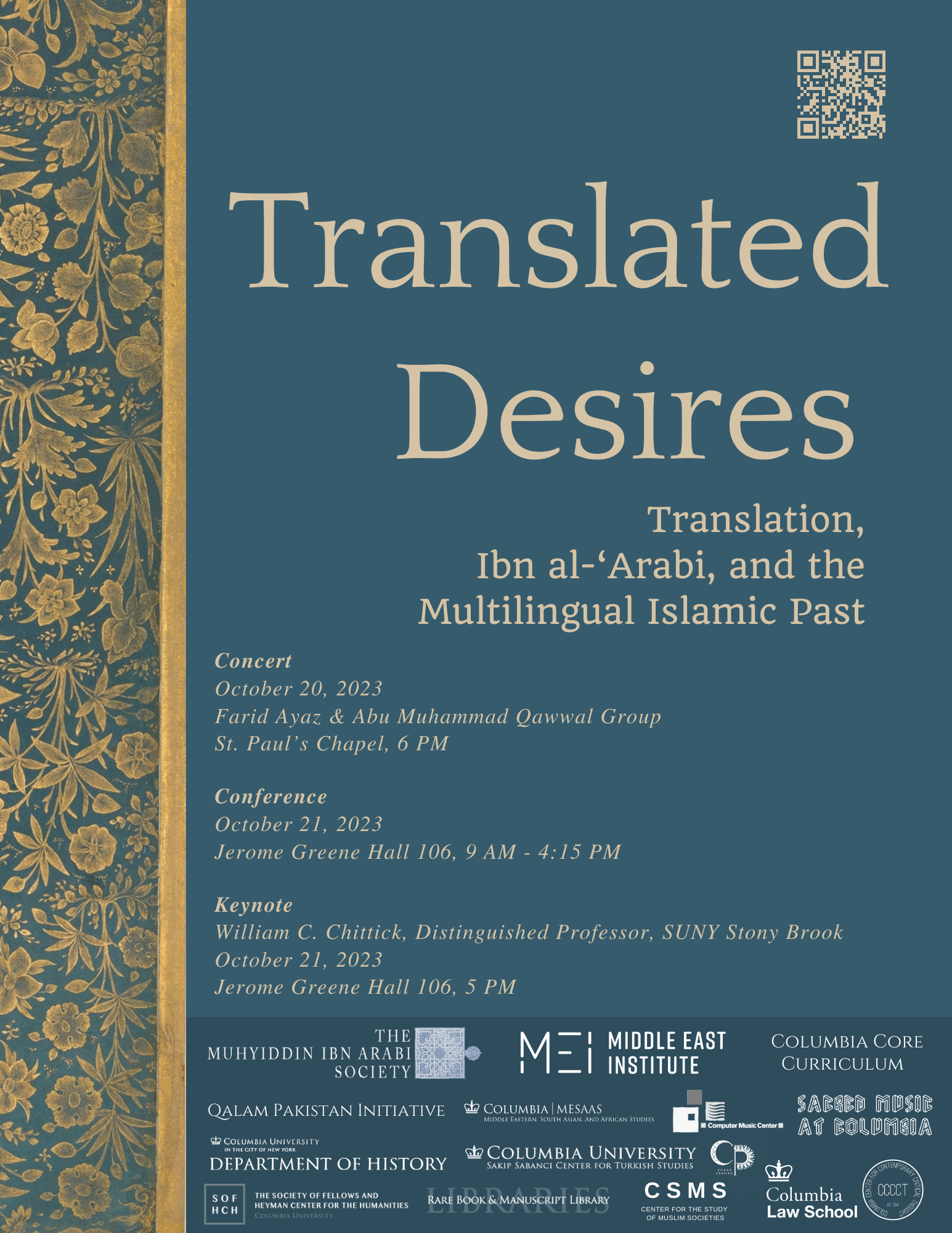
Five Insights from The 2023 Ibn 'Arabi Symposium at Columbia University
When I first began the practice of ally work, I learned about Ibn ‘Arabi in Dr. Jeffrey Raff’s writings. He described Ibn ‘Arabi’s understanding of the imaginal and the ally figure as perhaps the closest to his own understanding that he had encountered.
From Raff’s pointer, I then read Henry Corbin’s scholarly translations and deep reflections on Islamic mystics—particularly Surhawardi, Avicenna, and Ibn ‘Arabi.
I then discovered the wonderful resource of the Ibn ‘Arabi Society (https://ibnarabisociety.org), and its great wealth of resources on Ibn ‘Arabi, such as podcasts, articles, and related publications.
This led to my ongoing engagement with Ibn 'Arabi's teachings, particularly though Dr. Eric Winkel's translation and online classes of Ibn 'Arabi's 10,000 page text The Futuhat (https://thefutuhat.com).
From my point of view, Ibn ‘Arabi is a pivotal figure in what we might see as a cross-cultural and transhistorical engagement with what Raff calls ally work — our imaginal and transpersonal discourse with the divine.
So it was a joy to attend my first Ibn ‘Arabi Symposium this year at Columbia University — and meet some of the kind, dedicated, and warm-hearted trustees of the Ibn ‘Arabi society—while learning from a panoply of passionate academics engaged in Ibn ‘Arabi’s legacy.
I felt inspired to record these insights and takeaways from the conference while they were still fresh in my being.
Conference Title: Translated Desires: Translation, Ibn al-ʿArabī, and the Multilingual Islamic Past
Conference Description: The writings of Ibn al-ʿArabi (d. 1240), one of the most influential Sufi Muslim theoreticians of the medieval period, touched all aspects of knowledge in Asia and Africa in the centuries after his death. This workshop will take as its objective a global history of translation and language in both the dissemination and reception of Ibn al-'Arabi's writings through discourse, music, and art.
Conference Speakers: Ali Karjoo-Ravary, Kazuyo Murata, Maria Dakake, Mohammed Rustom, Rosabel Ansari, Marlene Dubois, Amer Latif, Atif Khalil, Oludamini Ogunnaike, Shankar Nair, Sachiko Murata, William C. Chittick.
Read more about the conference: https://www.mei.columbia.edu/mei-event/translated-desires