From Real to Complex: The Ally as a Higher-Dimensional Form of Being

As humans, we often limit our conception of reality to what we can observe through our senses. However, we know that there is so much more to existence than meets the eye: the microscopic world, quantum objects, dark energy, and dark matter.
Ibn 'Arabi astutely describes the dilemma faced by those, including scientists, who confine reality to the realm of sensory perception. He portrays them as individuals who, when confronted with the limitations of their methodology, respond by saying, "There is no other basis for knowledge we can rely on." Yet, when questioned about the foundation of their argument, they evade by claiming that their statement does not qualify as knowledge—does not make any truth claims.
Dr. Eric Winkel, in his translation of Ibn 'Arabi's passage, remarks that the principle of accepting only observationally testable principles as scientifically valid is itself untestable through observation.
Consider the diagram below depicting complex and hypercomplex numbers, which represent number systems ranging from real numbers (one-dimensional) to voudons (256-dimensional).
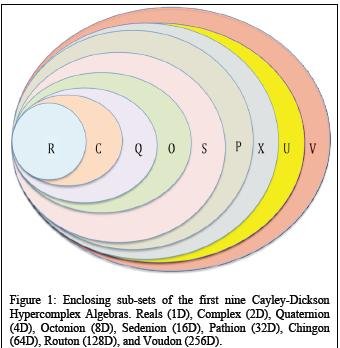
By way of analogy, asserting that three-dimensional sensory data is the sole reality would be akin to claiming that real numbers are the only numbers in existence.
Interestingly, until the 18th century, mathematicians adhered to the belief that only real numbers existed. When a new category of numbers was proposed, Descartes, in anger, dubbed them imaginary numbers—a name that has persisted. However, mathematician Carl Friedrich Gauss argued that imaginary numbers are not mere fabrications; they make perfect sense and can be visualized. They exist alongside the real numbers, like an additional dimension—an extension of the real number line.
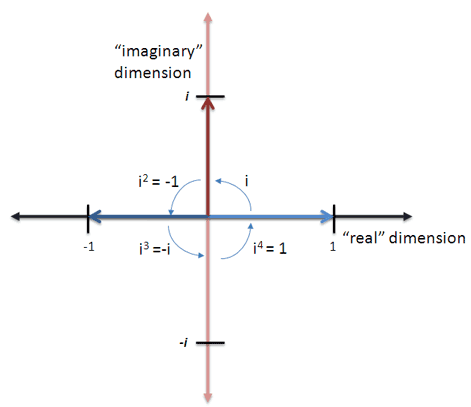
Gauss suggested that the confusion surrounding imaginary numbers stemmed from their misleading names. If, for instance, +1, -1, and the square root of -1 were referred to as direct, inverse, and lateral units instead of positive, negative, and imaginary (or even impossible), the mystery would have been dispelled.
The discovery of imaginary numbers led to the realization of complex numbers, which combine both real and imaginary components. In graphical terms, a complex number represents a higher-dimensional reality than a real number. Here’s a gorgeous and dynamic video depiction of a modular form based on complex numbers. (See the Quanta article for more.) [Editor’s Note: The modular form in the video resonates with me as a visual metaphor for encountering the ally.]
So, how does this relate to ally work? We can consider the encounter with the ally as a higher-dimensional form of being. In this analogy, humans can be likened to real numbers, while the ally represents an imaginary number. When we unite the ally and the human, we create a complex number—a complex being.
But the story doesn't end there. We can envision the ally as having its own ally or a higher level of complexity. Just as mathematicians started by exploring higher-dimensional number systems proximate to the real numbers, such as complex, quarternions, and octonions, it is simpler and more accessible for us as humans to engage with higher dimensions of being that are closer to us—what we may call the ally.
It is crucial, however, to recognize that the ally is not the ultimate destination; it serves as our near field guide on the path—a valuable entry point into an ecosystem of Oneness. In spiritual terms, as Ibn 'Arabi would articulate it, the ally represents a facet of our private face to the divine.
As humans, we often confine our understanding of reality to the transient and ever-changing sensory world. We grasp onto what appears and disappears, subject to the whims of time and space. However, there exists a realm of knowledge beyond the fleeting nature of sensory perception.
Here is a poem by Ibn 'Arabi from The Futuhat reflecting these insights—alluding to the timeless reality that lies beyond the transient world:
"Knowledge of existence passes on, transferring.
And knowledge of the Face—no expectation
is there for its disappearance."
In the words of Ibn 'Arabi, "Knowledge of existence passes on, transferring," implying that the knowledge derived from the sensory realm is impermanent and transitory. It flows from one moment to the next, ever-changing and transient.
Yet, there is another dimension of knowledge—the knowledge of the Face, the divine—that remains eternal and unchanging. It is not subject to the ebb and flow of the sensory world. When we metaphorically turn our face toward the ally, we venture into a dimension of our being that transcends the constraints of space and time.
In these verses, we are reminded that the knowledge we seek is not founded in the transitory, but grounded in the eternal. By embracing the ally, we engage in a journey that transcends the limitations of our sensory experience and opens us to the meaning and connection in the timeless nature of true being.